01 — REVIEW2–4 days on site
Survey & brief
We measure the building, not the PDF. Every opening, structural return, ceiling height, level change and service position is recorded and reconciled against your architectural set. Where travel is not practical, we work through your survey pack and return a list of what is missing before pricing anything.
The brief is taken in the same visit: how the space has to feel, how it will be used, what has to be maintainable, and what the client has already rejected elsewhere.
You receive: a measured survey with reconciled dimensions, a written brief, and a conflict list of every point where the drawings disagree with the building.
02 — DEVELOP5–8 working days
Shop drawings
Renderings and reference images cannot be manufactured. We convert intent into fabrication drawings: substrate and core build-up, veneer layon direction and flitch sequence, edge profiles, shadow gaps, hardware positions, fixing methods and the tolerance each junction will actually hold.
Drawings are issued as a numbered set with a revision cloud on every change, so your consultant can review without re-reading the whole package.
You receive: a complete shop drawing set, PDF and DWG, with a cover sheet listing exactly which sheets need your approval and which are informational.
03 — CHECK2 rounds typical
Detail review
Before anything is cut, we sit through the set with you line by line: proportions, sightlines, junctions between trades, and the places where the architect's detail and the site condition cannot both be true. Unresolved items are closed here or marked as an accepted risk in writing.
A revision at this stage costs a redraw. The same revision after production costs a crate.
You receive: a marked-up review set, a written resolution list, and a locked revision stamped for production — the only revision the workshops are allowed to work from.
04 — CUSTOMISE1–3 weeks
Material palette
A project usually carries fifteen to forty finishes across stone, timber veneer, metal, terrazzo, glass and textile. Bought one by one from separate suppliers, they drift: the grey stone goes warm, the bronze goes yellow, the veneer goes red against the sample board.
We build one palette, in one place, reviewed under the same light — and tell you where a specified item cannot be matched, will not pass fire rating, or will not arrive in time.
You receive: a consolidated finish schedule with physical samples, matched alternates for anything unavailable, and a lead-time flag on every long-lead item.
05 — CONFIRM7–12 days per round
Sample approval
Nothing enters batch production without an approved sample. A panel means a full-size bay in the real finish. A counter means the actual edge and the actual sheen. A chair means a 1:1 prototype that can be sat on and pushed across a floor.
Samples are photographed against a colour reference and couriered where you cannot inspect them in person. Approval is recorded in writing, with the sample retained as the production standard.
You receive: the sample or mock-up, a photographic record with colour reference, and a signed approval sheet that becomes the rejection standard at pre-shipment.
06 — PRODUCE4–8 weeks
Factory coordination & QC
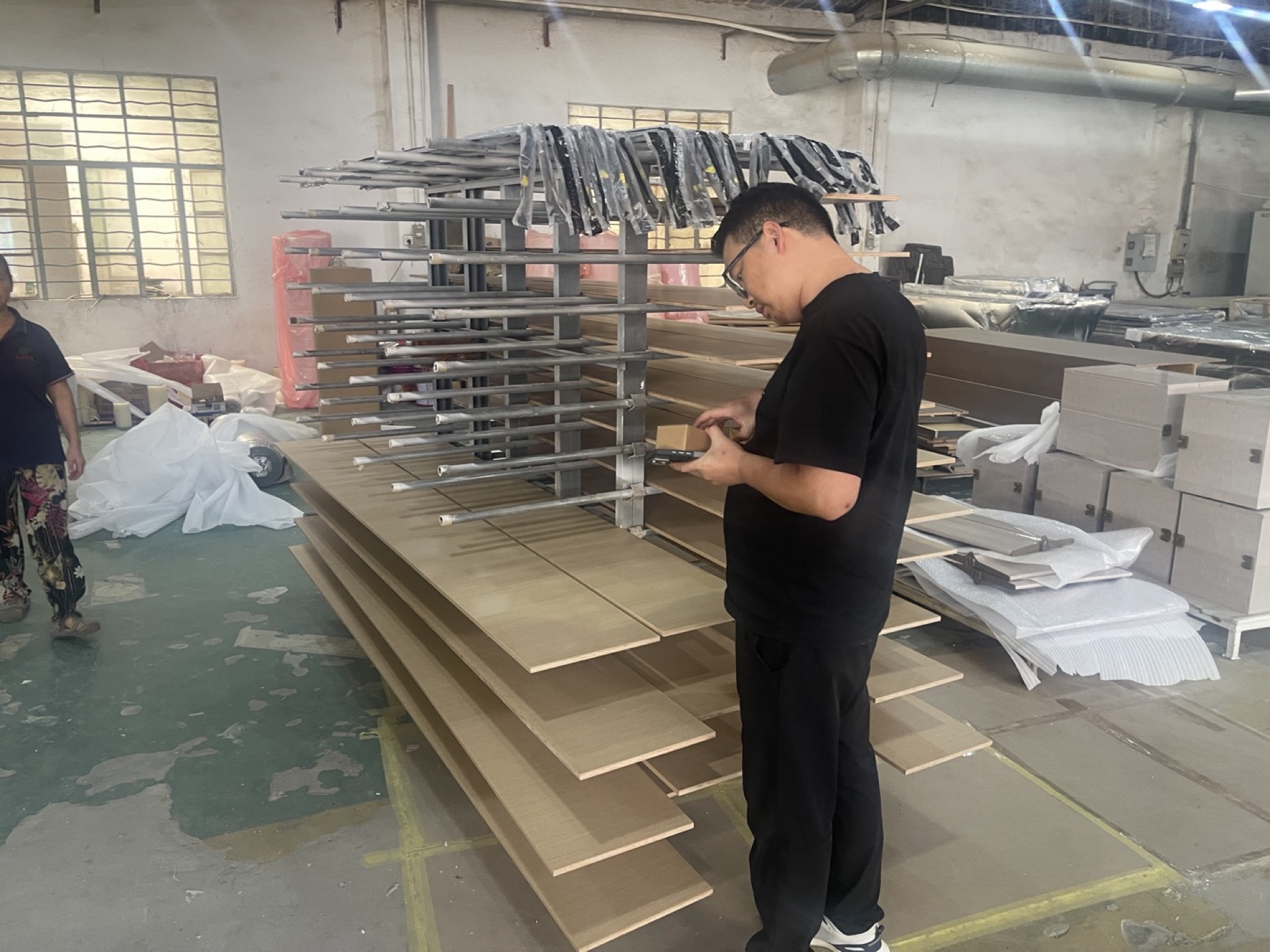
We are in the workshops rather than emailing them. Incoming material is checked against the approved sample, first articles are reviewed against the drawing before the run continues, and every discipline reports into one schedule and one contact.
Five checkpoints can each stop production: incoming material, first article, mock-up, in-process, pre-shipment.
You receive: a weekly progress report with photographs, first-article and in-process inspection records, and a full pre-shipment inspection report before crating begins — whether or not you ask for it.
07 — DELIVER3–5 weeks at sea
Shipping & installation
All disciplines are packed to one load plan so a hotel package arrives as a calculated number of containers rather than an accidental one: ISPM-15 heat-treated crates, corner board and foam on every finished edge, moisture barrier with desiccant, internal bracing so nothing shifts at sea.
We ship FOB Shenzhen / Yantian or CIF to your port, and work with your forwarder or nominate one. Where the project needs it, our supervisors travel to close out the installation — levels, junctions, final adjustments — and work through the snag list with your site team.
You receive: a packing list per container, full shipping documents, installation drawings keyed to the crate numbers, and a closed snag list signed off on site.